Expressvpn Glossary
Access point name

What is an access point name?
An access point name (APN) is a configuration that identifies the network and connection settings a mobile device uses to connect to the internet or a private corporate network through a carrier’s mobile network. APNs are used by devices operating on any generation of cellular network, from 2G through 5G.
How does an APN work?
APN names contain two parts: the network identifier and the operator identifier. The network identifier determines which services a device can access, such as the internet or a private internal network. The operator identifier specifies the mobile carrier that provides the connection, typically referencing the provider’s network domain.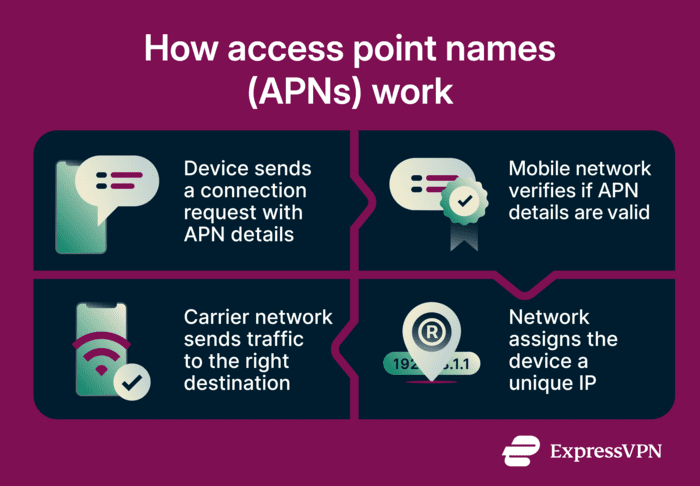
When a device uses an APN to connect to a network, several steps take place in the background:
- The device sends a connection request to the mobile network that includes the configured APN details.
- The mobile network verifies that the APN is valid and checks whether the device is authorized to use it.
- If the request is approved, the network assigns the device a unique IP address so it can communicate on the network.
- The mobile network then routes the device’s traffic to the appropriate destination, such as the public internet or a private network.
If the APN connects to a private network, additional security measures, such as access control, may be applied when the connection is established.
Public vs. private APNs
APNs are commonly grouped into two types: public and private. Public APNs are the default configurations used by cellular carriers to connect consumer devices to the internet through their mobile data networks, while private APNs are typically used by organizations to provide secure access to internal networks.
| Public APNs | Private APNs | |
| Accessibility | Available to most mobile subscribers and typically preconfigured by mobile carriers | Restricted to specific users, devices, or organizations |
| Security level | Standard carrier-level security, but traffic usually routes through the public internet | Higher isolation, often with additional controls such as access policies or private routing |
| Cost | Low cost, as devices use standard carrier mobile data plans | Higher cost due to dedicated configuration and management requirements |
How is an APN configured?
On consumer devices, APNs are usually provisioned automatically when a SIM card is inserted, either pre-loaded on the SIM or pushed over-the-air by the carrier. When manual configuration is required, such as when using a third-party SIM, users can manually edit or add APN details through the device's network or cellular settings menu.
When managing large device fleets or Internet of Things (IoT) deployments, many organizations use mobile device management (MDM) platforms or cloud-based management systems to centrally configure and remotely deploy APN settings across all devices.
Risks and privacy concerns
Common APN-related issues that can raise security and privacy concerns include:
- Misconfigurations: Poor APN setups may expose sensitive data or allow unauthorized access to networks and connected devices.
- Data interception: Public APN connections that rely only on carrier-level protections may expose data to monitoring if additional encryption isn’t used.
Further reading
- What are IoT networks? A complete guide
- What is IoT connectivity, and how do you choose the right solution?
- The ultimate guide to wireless access points
- Network connections: Everything you need to know